
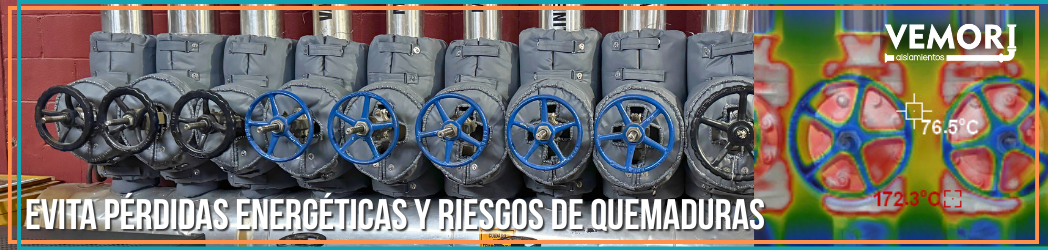
In most industrial plants, thermal insulation is a key factor in ensuring efficiency and safety. However, one of the most overlooked aspects is valves, essential components for regulating fluid flow and temperatures in processes.
Without insulation, valves become sources of energy loss and high-risk surfaces for personnel. For this reason, removable insulation has become the best solution: it is practical, reusable, and offers both economic and safety benefits.
The Problem of Uninsulated Valves
1. Constant Energy Loss
Valves work with fluids that reach very high temperatures. When left uninsulated, these surfaces continuously release heat into the environment. This "lost heat" forces equipment to consume more energy to maintain operating conditions.
- This translates into higher energy costs.
- It affects the thermal stability of processes.
- It reduces the overall efficiency of the plant.
2. Risk of Burns
An unprotected valve can reach temperatures of up to several hundred degrees Celsius on its external surface. For maintenance personnel or operators working nearby, accidental contact is enough to cause a serious burn.
- It increases the risk of workplace accidents.
- It can generate additional costs for medical care and operational downtime.
- It damages the confidence and safety of the work team.
Resume: an uninsulated valve represents economic losses and a danger to people.
The solution: removable valve insulation
The Vemori's removable insulation consists of a custom-made thermal cover or jacket, designed to enclose the valve and prevent heat from escaping into the environment. Unlike traditional fixed insulation, this can be removed and reinstalled as many times as necessary.
This makes it a practical solution for valves, as they are components that require constant inspection and maintenance.
Main benefits of removable valve insulation
- Immediate energy savings: By covering the valve, heat is retained within the system instead of being lost to the environment. This reduces energy consumption and improves equipment performance.
- Personnel protection: External surfaces are maintained at a safe temperature, preventing accidental burns and complying with workplace safety regulations.
- Hassle-free maintenance: The removable design allows for quick removal of the insulation for inspections, repairs, or valve replacements, and reinstallation without affecting operation.
- Durability and Resistance: They are manufactured with materials designed to withstand high temperatures, humidity, and demanding industrial conditions, guaranteeing a long lifespan.
- Guaranteed Return on Investment: The reduction in energy losses and workplace hazards translates into tangible savings that allow for a quick return on investment.
Impact on Plant Efficiency and Safety
Using removable valve insulation is not just a technical improvement; it's an optimization strategy.
- In terms of efficiency: it reduces energy costs, improves thermal stability, and reduces equipment wear.
- In terms of safety: it protects workers and prevents burn-related incidents.
- In terms of sustainability: by making better use of energy, the carbon footprint is reduced, and the company reinforces its commitment to the environment.
Conclusion
Valves without insulation represent losses and risks that often go unnoticed. Implementing removable valve insulation is a simple solution that generates visible results on three fronts: energy savings, personnel safety, and operational continuity..
At Vemori we design and install custom-made removable insulation, ensuring maximum protection, efficiency and durability for every valve in your plant.
 English
  Spanish