
The Economic Impact of Removable Thermal Insulation in Industry
Introduction: A Silent Loss Affecting Your Profitability
In most industries with thermal processes, such as manufacturing, food and beverage, chemical, automotive, and paper, attention is usually focused on production equipment and process control. However, there is a constant leak that is rarely measured accurately: the heat lost through metal surfaces exposed to high temperatures.
This loss not only represents a decrease in the plant's thermal efficiency but also a direct economic cost that is repeated every hour, every day, every year. In many cases, the fuel expenditure generated by not having adequate insulation far exceeds the cost of correcting the problem.
The objective of this article is to demonstrate, with real data, how an investment in removable thermal insulation can translate into significant savings, with a short-term return on investment and sustained benefits over time.
What is removable thermal insulation?
Removable thermal insulation is a solution designed to cover equipment that operates at high temperatures (such as valves, steam traps, elbows, filters, flanges, and manifolds), allowing for the retention of internal heat and reducing energy loss to the environment.
Unlike fixed or conventional insulation, the removable system has several key advantages:
- It can be easily disassembled for equipment maintenance without damage.
- It can be reused as many times as necessary.
- It is custom-designed, guaranteeing a perfect fit and more efficient thermal performance.
- It uses high-performance materials capable of withstanding extreme temperatures and harsh industrial conditions.
In projects developed by VEMORI, these systems have demonstrated not only technical efficiency but also a measurable economic impact on our clients' operating costs.
The Diagnosis: When Heat Becomes Wasted Money
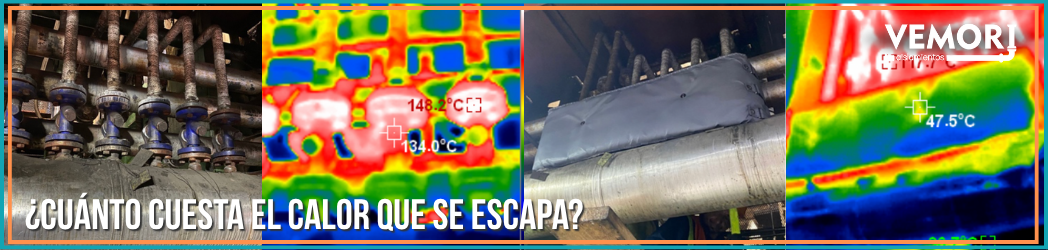
Before making technical decisions, it is important to understand the problem. In our projects, the starting point is a thermographic field diagnosis . Using specialized cameras, we identify metal surfaces that are constantly dissipating heat.
In one of the cases analyzed, more than 100 industrial components in operation were inspected, including:
- Valves from 1.5” to 12”
- Flanges and expansion joints
- 90-degree elbows
- Exposed piping
- Filters and steam manifolds
The average operating temperature was 374°F (190°C), compared to an ambient temperature of 75°F (24°C). This temperature difference, multiplied by the exposed surface area, represents a constant energy loss.
Using specialized thermal analysis software (such as 3E Plus), the annual energy loss from these uninsulated components was estimated to exceed 18 million BTUs.
How much does this lost energy cost?
To understand the true impact, the BTUs were converted to natural gas consumption. Based on the following parameters:
- Energy content of natural gas: 1,026 BTU/ft³
- Average cost of natural gas: $5 USD per thousand cubic feet (Mcf)
It was determined that energy losses are equivalent to a direct fuel consumption expense of more than $118,000 USD annually.
But the figures don't end there.
Even considering an insulation efficiency of 80% (to account for joints, cuts, and adjustments), the estimated realistic savings were $94,543.97 USD per year..
Furthermore:
- Each square foot insulated generates an average annual savings of $48.14 USD..
- The return on investment is achieved in less than 12 months.
- The lifespan of the removable system exceeds 10 years.
In other words, it is an investment that pays for itself in the first yearand continues to generate returns for a decade or more.
Applied Engineering: What materials are used?
Industrial thermal insulation cannot be improvised. To guarantee thermal performance, mechanical durability, and ease of installation, VEMORI uses a combination of certified technical materials:
Insulating Core
- High-density ceramic fiber (8 lb/ft³)
- 2” Thickness
- Withstands up to 1,260 °C
Outer Cover
- Fiberglass fabric coated with fire-retardant and waterproof Teflon (Lewco 1650 T)
- Mechanical and chemical resistance
Inner Face
- Type 304 stainless steel mesh
- Lewco 9383 fabric (thermal resistance up to 1,100 °F)
Fastening Elements
- Stainless steel staples, clips, or straps
- Ergonomic design for easy installation
This system allows each thermal blanket to be removed and reinstalled multiple times without losing its thermal or structural properties.
Beyond Savings: Operational and Environmental Benefits
In addition to energy and cost savings, removable thermal insulation offers operational and environmental benefits that make it a strategic tool:
1. Industrial safety
Reduces the risk of burns from contact with hot metal surfaces, especially on valves and manifolds accessible to personnel.
2. Environmental sustainability
Lower fuel consumption means fewer emissions of polluting gases, contributing to compliance with environmental policies and ESG goals.
3. Uninterrupted maintenance
The system is easily removed during inspections or repairs without breaking or deteriorating, avoiding additional replacement costs.
4. Aesthetics and order
The plant gains a better visual appearance, reinforcing a culture of order, cleanliness, and thermal control.
Where to begin?
An initial thermal audit is the first step. This assessment identifies the points of greatest energy loss and prioritizes the components with greatest economic impact per square meter..
In many cases, 30% of the exposed components account for 70% of the losses, so it is not necessary to insulate the entire plant to obtain significant benefits.
Based on this diagnosis, a technical report is generated with:
- Analyzed parts and recorded temperatures
- Calculation of lost BTUs and their conversion to gas consumption
- Estimated annual savings and return on investment
- Technical proposal for removable insulation
Conclusion: Insulate the heat, unlock profitability
Removable thermal insulation is not just an operational improvement. It's a strategic decision with measurable, sustained, and scalable benefits.
While other investments require years to recoup their cost, well-designed thermal insulation can pay for itself in less than a year and continue generating benefits for more than a decade.
In a context where energy costs are rising, competitiveness is paramount, and sustainability is non-negotiable, insulating against heat means protecting your margins, your operations, and your future.
 English
  Spanish