
In the industrial world, there are many critical areas that aren't always visible. A clear example: equipment operating at high temperatures that, due to a lack of thermal insulation, exposes facilities to multiple risks. Although energy consumption is often discussed as one of the consequences, the reality is that this is only the beginning.
This blog isn't just about thermal efficiency. It's about protection. About safety. About making decisions that prevent accidents, extend the lifespan of equipment, and optimize resources that are often lost through negligence or habit.
The real problem isn't the heat, but ignoring it.
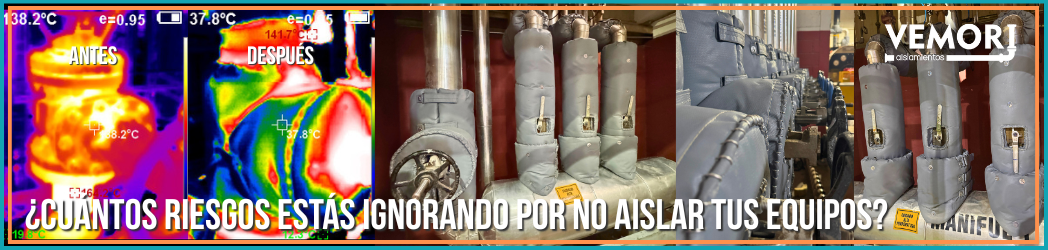
In a recent technical inspection, various pieces of industrial equipment were found operating without any thermal insulation. Components such as valves, steam traps, and flanges had surface temperatures exceeding 100°C. At first glance, the system was still functioning. But at an operational level, the risks were cumulative and evident.
Exposure to these temperatures can have serious consequences. First, it represents a constant danger to operating personnel who work near this equipment. An accidental brush against a hot valve is enough to cause a serious burn, compromising not only the worker's safety but also the continuity of the production process. These types of incidents result not only in injuries but also in work stoppages, reports, penalties, and a loss of confidence in safety procedures.
But the risks are not limited to the human factor. Many of these machines operate in spaces that also contain sensors, cables, and control systems. Uninsulated heat slowly deteriorates these electronic components. Over time, this constant thermal exposure generates intermittent failures, disconnections, or signal errors that affect the accuracy of the entire system. What seemed like a minor technical detail ends up becoming an operational headache.
Furthermore, the mechanical effects must be considered. Metal components subjected to constant temperature changes suffer thermal fatigue. Valves, for example, lose their structural tolerance more quickly when they are not protected. This increases the frequency of corrective maintenance, shortens the lifespan of parts, and raises costs due to unforeseen replacements.
And yes, there's also the energy consumption. Every uninsulated surface acts as a heat loss point. The plant needs more energy to maintain the desired internal temperature, which translates directly into higher electricity bills and a greater environmental impact.
Technical Diagnosis: When Data Confirms What Can't Be Seen
To understand the scope of the problem, a thermographic study was conducted using specialized equipment. The objective was to identify critical points of heat loss, record the actual temperatures, and estimate the impact on energy consumption.
The inspection confirmed the obvious: all uninsulated areas exhibited dangerously high surface temperatures. These points were located in both visible and hard-to-reach areas, which explained why they hadn't been addressed before. However, these invisible points were responsible for constant losses that, accumulated over time, represented a high cost for the plant.
This diagnosis not only served to identify the affected equipment but also to determine what type of solution was viable based on the environment, the materials, and the need to maintain operational access for future inspections or maintenance.
Removable Thermal Insulation: A Solution That Goes Beyond Savings
Based on technical analysis, a removable thermal insulation system was chosen. This type of solution allows for covering high-heat equipment without compromising accessibility. Unlike fixed insulation, the removable system can be easily disassembled for maintenance and then reinstalled without compromising its integrity.
The design was custom-made, taking into account the exact dimensions of each component and its immediate surroundings. High-strength materials were used, such as 2-inch thick ceramic fiber with a density of 8 lb/ft³, capable of withstanding temperatures up to 1,260°C. The outer layer was made of fiberglass fabric impregnated with fire-retardant and waterproof Teflon, while the inner layer included stainless steel mesh and technical fabric resistant to 1,100°F. The entire system was assembled with stainless steel staples and fasteners, ensuring durability, mechanical strength, and reusability.
This insulation not only controls temperature, it also protects. It acts as a barrier between the heat from the equipment and the environment, preventing the creation of hazardous areas and damage to other components, and that energy is wasted.
Results that speak for themselves
Once the system was installed, post-installation tests were conducted to validate its effectiveness. Surface temperatures decreased dramatically, eliminating immediate risks to personnel. The reduction in heat loss allowed for the estimation of significant annual energy savings, in addition to an improvement in system efficiency.
Furthermore, the implementation of the removable system facilitated the periodic inspection of equipment without the need to destroy the insulation, which reduces operating costs and improves the responsiveness of the maintenance team.
Nearby sensors and cables were protected from direct heat, extending their lifespan and preventing future failures. In short, a safe, reusable, and technically sound solution was achieved, aligned with the operational objectives of any modern industrial plant.
This is how we work at Vemori: from problem to solution, step by step
At Vemori, we know that every plant, every piece of equipment, and every situation requires a unique approach. That's why our process is designed to support the client from the very beginning, with technical clarity and genuine commitment.
It all begins when the client contacts us and explains their problem. This could be a suspected heat loss, an internal complaint about unsafe conditions, or simply a technical question. In this initial stage, we listen, provide guidance, and assess whether an on-site thermal diagnostic is necessary.
If the case requires it, a thermographic inspection is scheduled on-site. During this technical visit, our team identifies critical areas, records temperatures, and prepares an initial technical report. From there, we conduct a physical survey of the equipment, taking precise measurements for the design of the insulation system.
With this information, we generate a clear technical and economic proposal, which includes details of the materials, delivery times, and expected impact. After approval, the manufacturing of the thermal blankets begins in our workshop, under strict quality controls. Finally, the system is installed on-site, adjusted, and its performance is verified with real-world measurements.
Each project concludes with the delivery of a technical report that includes temperature comparisons, photographic evidence, maintenance recommendations, and everything necessary to ensure the system's long-term continuity.
Thermal insulation is prevention, protection, and efficiency.
Insulation is often discussed as an energy solution, but its impact is much more profound. When implemented correctly, it not only reduces consumption but also protects the physical safety of personnel, safeguards sensitive electronic systems, prevents premature component wear, and facilitates future maintenance.
Removable thermal insulation is a smart investment for any operation that values efficiency and safety. Most importantly, it's a solution that adapts to the equipment, the environment, and the specific needs of each industry.


 English
  Spanish