
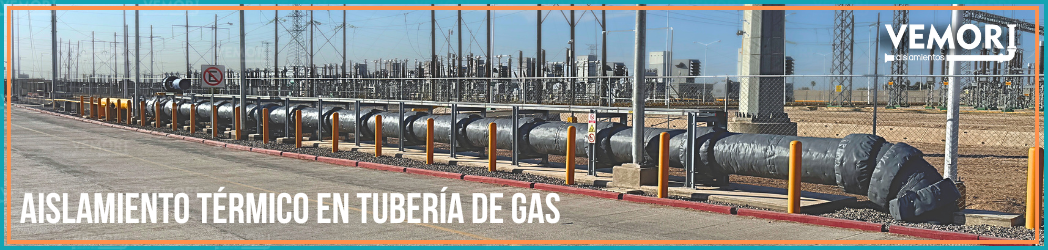
Industrial pipelines, especially those transporting gas at high pressure or temperature, can become a critical point within a plant: they generate noise, lose energy, and affect operational efficiency. While this may seem like an unavoidable problem, specialized technical insulation offers effective, long-lasting, and rapidly implementable solutions.
Why do industrial pipelines generate noise?
There are several technical causes of noise in a pipeline network, among the most common being:
- Turbulent flow: When gas moves at high speed, it generates friction against the internal walls, causing constant vibrations.
- Water hammer: Sudden pressure changes, such as the rapid closure of valves, generate shock waves that result in noise and mechanical stress.
- Interaction with valves, elbows, or flanges: These fittings interrupt the flow line, creating areas of high turbulence.
- Structural vibrations: The entire system can amplify sound due to internal resonances in the metal structure of the pipelines.
These conditions not only affect the acoustic comfort of the work environment but can also trigger premature structural failures if not properly controlled.
Energy losses: the other silent problem
In addition to noise, uncontrolled heat transfer through the pipes also results in significant losses. This translates into:
- Decreased thermal efficiency of the system.
- Increased energy costs to maintain operating temperatures.
- Potential failures due to condensation or corrosion in sensitive areas.
A Practical Case Study: Acoustic Insulation Solution for a Gas Pipeline
Recently, an acoustic insulation project was developed for an industrial gas pipeline network with diameters up to 24 inches. The objective was to significantly reduce the structural noise generated by turbulent flow and interactions with elements such as valves and elbows.
Problems Identified:
- Noise levels exceeding 84 dB in some critical sections, especially around valves.
- Risk of non-compliance with workplace noise exposure regulations.
- Vibrations that could damage supports or connections.
Solution Implemented:
- A removable acoustic insulation system was designed and implemented using a double layer of fiberglass (high and low density) reinforced with a Teflon coating.
- Specific pieces were manufactured to cover elbows, valves, straight sections, supports, and flanges, ensuring a complete system seal.
- A reduction of up to 11.9 dB was achieved in critical sections, such as around valves and elbows, representing a considerable acoustic improvement.
- The system was transported and installed on-site by Specialized technical personnel.
Furthermore, the insulation is removable, allowing for inspections and maintenance without damage. This ensures a long lifespan and low total cost of ownership.
Lessons Learned and Best Practices
- Layered Design: Combining materials with different densities improves sound absorption at various frequencies.
- Custom Manufacturing: The insulation must consider the complete geometry of the system, including support points.
- Environmental Resistance: Humidity and wear are key factors. The use of coatings such as Teflon is vital.
- Periodic Inspection: Although the system does not require complex maintenance, it is recommended to check the support points every six months.
Thermal and acoustic insulation in industrial piping not only improves working conditionsbut also offers energy savings, extends the system's lifespan, and reduces the risk of failure.
When properly designed and installed, these solutions become a key tool for increasing the operational efficiency of any industrial plant.

 English
  Spanish